
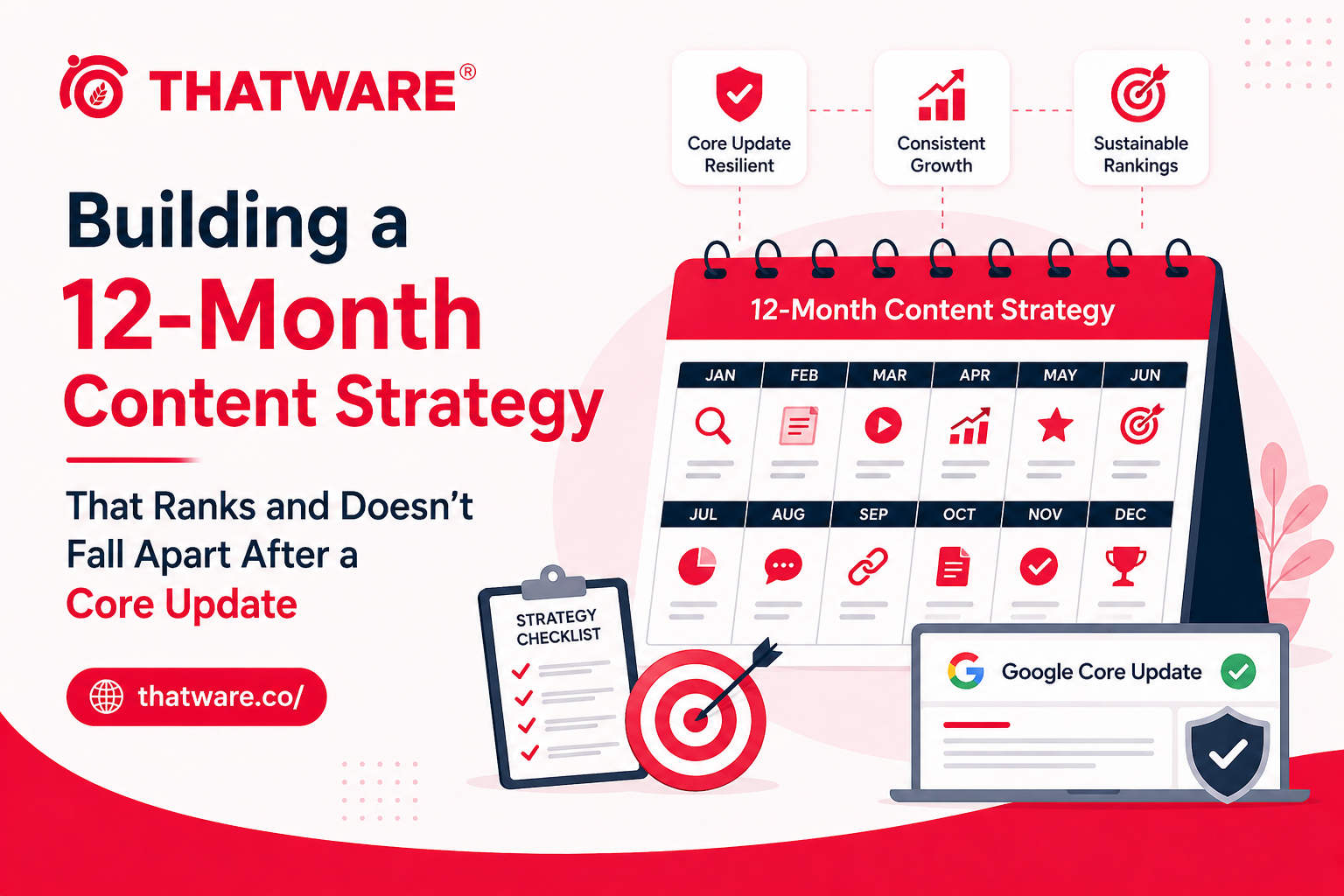
The content strategies that fall apart after core updates share a common design flaw: they were built to satisfy the current algorithm rather than to serve the current reader. That distinction might sound philosophical, but it’s deeply practical. Content built for the algorithm chases signals – keyword density, word counts, header structures – that the algorithm uses as proxies for quality. Content built for the reader builds the quality that the algorithm is trying to measure.
When Google updates its algorithm to better measure genuine quality, the first type gets demoted. The second type holds – and often improves, because the update brings the measurement closer to what the content was already doing.
Building a 12-month content strategy that’s genuinely update-resistant means starting from different premises than most content strategies do.
Why Most 12-Month Content Strategies Fail
The typical 12-month content strategy looks like this: keyword research producing a target list, organized by volume and difficulty, with content types and word counts assigned to each cluster, a publishing calendar distributing the work across the year, and metrics focused on rankings and organic traffic.
This is a reasonable framework. It’s also the framework that produces content that’s identical to competitors’ content in everything except the specific product or brand being described. When the algorithmic signals that differentiate this content from competitors change – as they do in core updates – there’s no underlying quality advantage to fall back on.
The content strategies that survive core updates have a different underlying logic. They start with the questions: What does our audience genuinely need to know? What can we tell them that nobody else can tell them as well? Where is the current content landscape failing the people searching for information in our category?
Audience Intelligence Before Keyword Research
The sequence matters. Most content strategies start with keyword data and then try to build content around it. Update-resistant content strategies start with audience intelligence – genuine understanding of what the audience needs, what they currently understand, and where existing content fails them – and then find the keyword opportunities that align with that understanding.
Audience intelligence sources: customer support logs (what questions do customers actually ask?), sales call recordings (what objections and misconceptions come up repeatedly?), community forums and Reddit threads in your category (what frustrations do people express that existing content doesn’t address?), competitor content comment sections (what do readers feel is missing?), direct customer conversations.
This intelligence reveals content opportunities that keyword tools don’t surface – gaps in quality rather than gaps in coverage. A topic might have abundant content but that content might consistently fail to address a specific use case, misconception, or practical implementation challenge that your audience faces. Content that addresses those gaps performs better than content that’s technically addressing the same topic at a surface level.
Content strategy services that start from audience intelligence rather than keyword volume produce strategies that feel different when executed – more specific, more genuinely useful, less interchangeable with competitor content.
The Topical Authority Architecture
A 12-month content strategy built for durability isn’t a list of target keywords; it’s a topical authority architecture. The distinction matters.
A keyword list tells you what to publish. A topical authority architecture tells you how your content should be organized to establish genuine domain expertise in the eyes of both readers and search systems. It maps the conceptual territory you’re claiming, identifies the content types that cover different dimensions of that territory, and plans the internal linking structure that communicates the relationships between pieces.
Concretely: a brand in the project management software category might claim authority over four sub-domains – team coordination, deadline management, resource allocation, and productivity methodology. Within each sub-domain, the architecture identifies a comprehensive content structure: overview content for broad queries, deep-dive content for specific challenges, use-case content for specific audience segments, comparison content for commercial queries, and tool/template content for implementation needs.
That structure – more than any individual piece of content – is what communicates topical authority to search systems. And it’s what holds up through core updates, because it reflects genuine knowledge organization rather than keyword targeting.
Depth Over Frequency: The Publish-Less-But-Better Argument
The single most consistent mistake in 12-month content planning is over-indexing on publishing frequency. More posts per week feels more productive. The content calendar looks more impressive. The output metrics are easier to justify in reporting.
The content that consistently performs well through algorithm changes, earns organic links, builds genuine topical authority, and generates the behavioral signals that indicate real value is almost always the stuff that takes significant effort to produce. Comprehensive guides that genuinely cover a topic. Research pieces with original data or analysis. Long-form how-to content that actually walks someone through a process they need to complete. Expert interviews that surface perspectives unavailable elsewhere.
A 12-month strategy built around 2 genuinely excellent pieces per month outperforms one built around 3 generic pieces per week – in search performance, in audience engagement, in the kind of organic authority building that compounds over time.
The argument against this is usually “we don’t have the resources to produce that level of quality at volume.” The honest response is: then produce less. A smaller number of genuinely excellent pieces is better, in every measurable way, than a large number of adequate ones.
The Update-Proofing Checklist
Content marketing services that build update-resistant strategies consistently apply a set of quality checks that go beyond standard SEO optimization:
Does this piece have genuine specificity that could only come from real knowledge? (Generic content fails this.)
Does this piece address the actual question in full – including the nuances, edge cases, and follow-up questions – rather than just the primary keyword topic? (Surface-level coverage fails this.)
Is there something in this piece that readers can’t find, in this form, anywhere else? (Commodity content fails this.)
Will this piece hold up if someone reads it in 18 months – or will it be outdated because it was built around current algorithm signals rather than enduring information? (Algorithm-chasing content fails this.)
Would a subject matter expert recommend this piece to someone asking them the question it addresses? (Thin content fails this.)
These are harder questions than “does this hit the target word count” or “does this include the focus keyword the right number of times.” They’re harder for exactly the reason that matters: the answers reflect whether the content is genuinely good, not just technically optimized. And genuinely good content is what holds up through the updates designed to find it.